55: Celebrating with a Kayakerator!


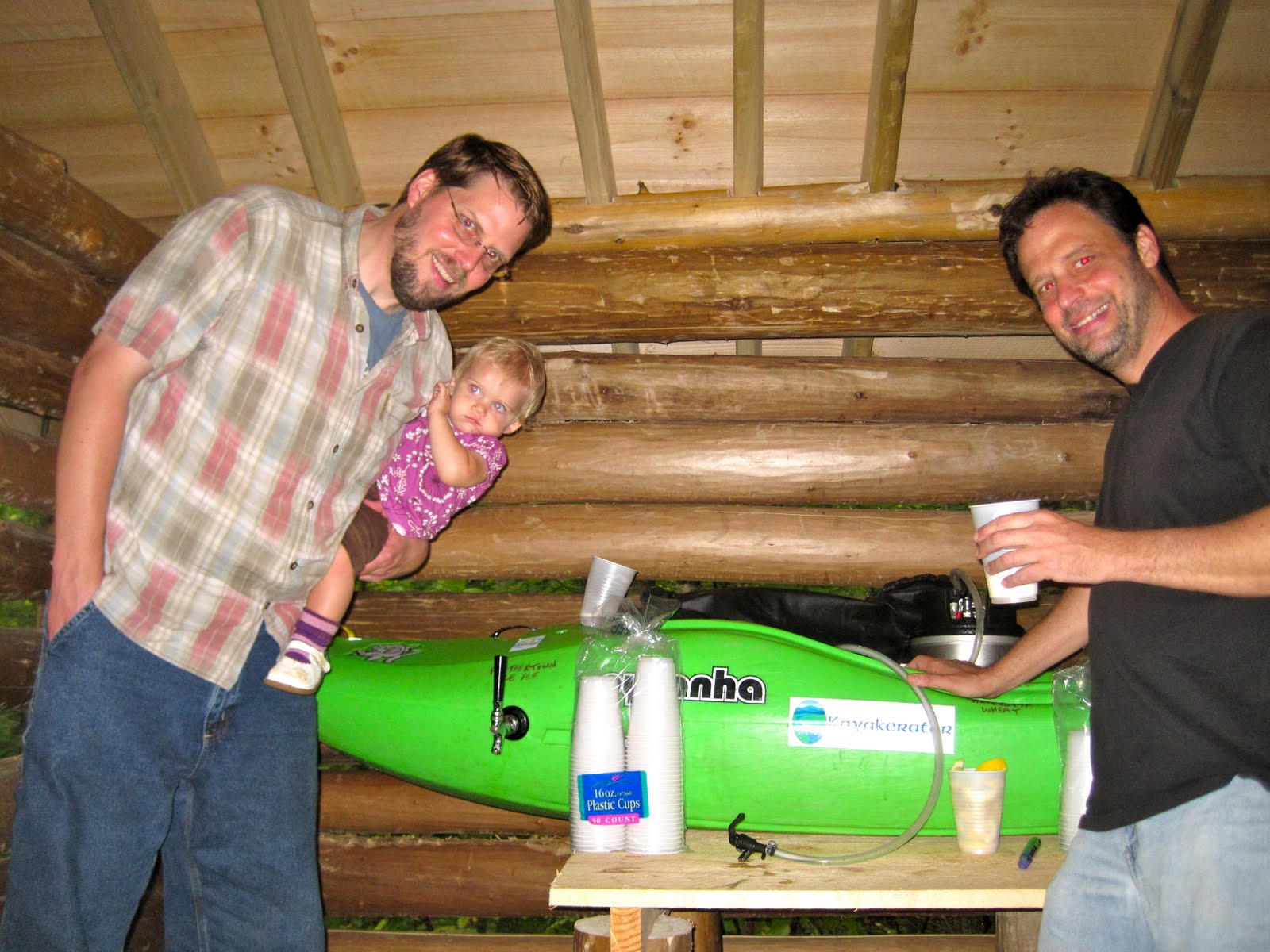
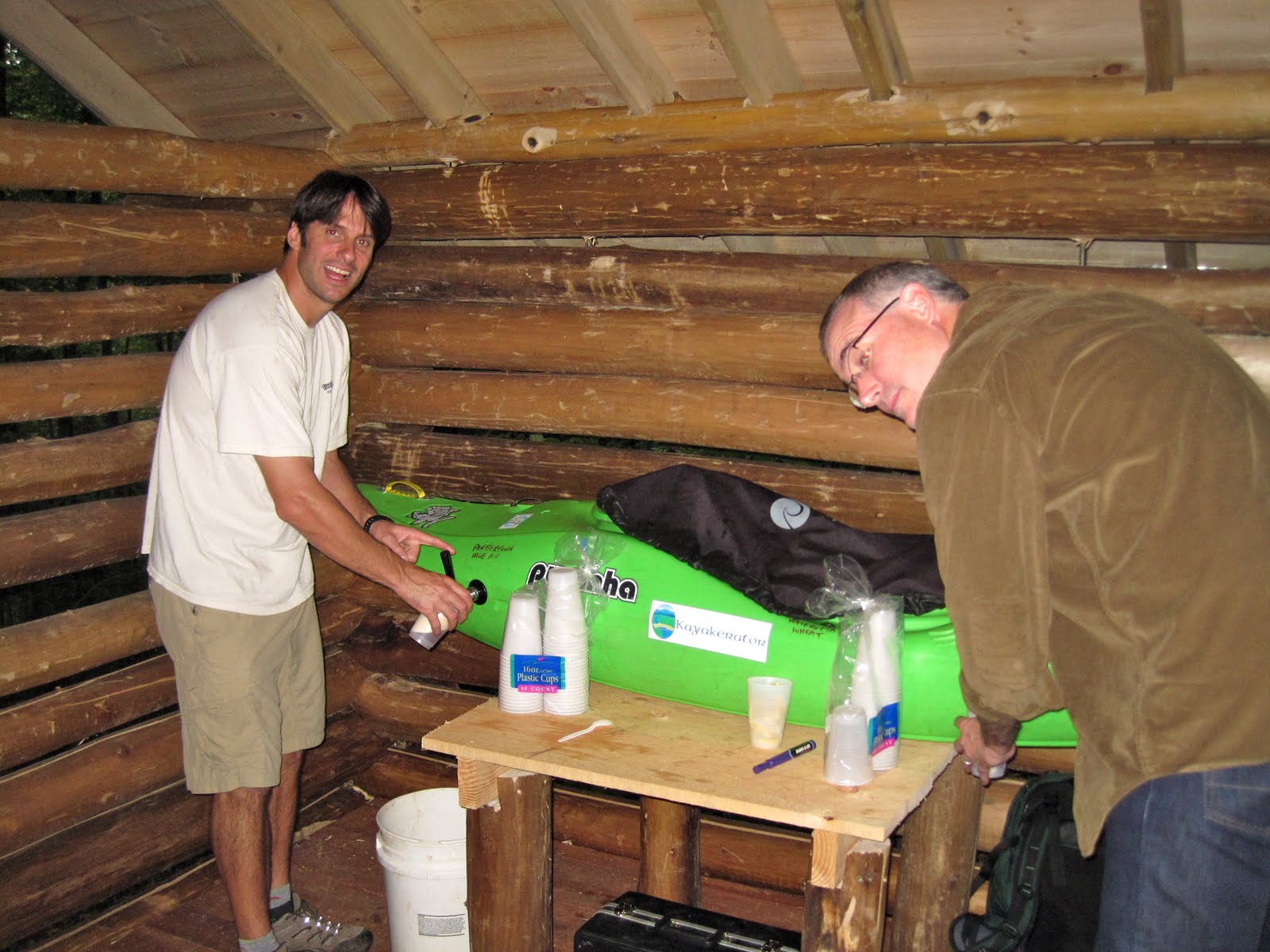
Saturday, lots of the folk who helped me along the way or even followed this blog came up the holler to raise a glass to a dried-in cabin! For the occasion, Sean, maker of phenomenal craft beers, brought the Kayakerator (TM) to celebrate -- our organization,Tuckaseegee Brewing Co-op, for which he is the brewmaster, uses this craft, donated by Dinver at Pyranha in Asheville, to dispense its peerless product, in this case one keg of Panthertown Pale Ale and one of Bonas Defeat IPA, both owing their beery goodness to Sean's craftmanship as well as the hops he grows right here in Jackson County.

I'll post a description of my building and completion process in a few days; meanwhile, here are some pictures from Saturday -- more of the party to follow in another post.

Sean with the guts of the Kakakerator

Mark approves!
Josh says, "Hey! this looks like MY BURN! OK, it's not. whew."
Sean with future brewer in arms, and colleague, Tuval.
Mike, loaner of drawknives and other sharp things!

Justin, floor joist helper, and Bill of wall-building exploits.

Lance and Lisa and Andrew, all NOC types.
The Master sampling his own cooking!


54: Finishing the roof!

I'm happy with the roof after deliberating what to do all summer. No time to use a froe and make my own shingles. It would be out-of-character and against the principles I've applied here to buy them at Cashiers prices. Cedar shakes are very expensive. Asphalt shingles would look just, well, wrong. That leaves tin as an appropriate, fitting building material that has adorned the scalp of many a cabin since the late 19th Century.

Thursday, Jon Ogburn came up the holler to help me with the roof. Although I've mostly done everything with the help of others and many things by myself, I'm (a) sprinting to a stopping point and wanted to get this done, (b) not hugely fond of being on roofs, and (c) aware that the charming lack of angular perfection has implications when placing perfectly square panels of tin. Plus, Jon's fun to have around, and he brings an appreciation of all the hand-tool work I've done to bring the cabin this far -- he worked with an Amish roofer for years. Like me, he makes concessions (used a battery drill). I just wish he'd worn his black wide-brimmed hat yesterday!


Tobias came by while Jon roofed and I was building log furniture. These guys represent two ends of the project. Tobias felled the trees, and Jon finished the roof.


Here's Jon, with his splendid, gleaming tin roof in the background. Until it fades a bit, you'll be able to see it from space.


53: Cutting a board for my roof!


Other boardcutting posts:
Handsaw (small)
Ralph Morgan interview
Handsaw (big, on the roof!)
Sawyer (ripping a log with a chainsaw)
Big saw!
Tale of two saws, part 1, part 2, and part 3

52: Interview with our very own local sawmill man

This interview speaks for itself.  Thanks Ralph!


Click Here to see Ralph in action!

51: Rafters and roof planks!

Last weekend, I hung all of the rafters, working alone.

As discussed in Chapter 38, I made some mistakes, but I corrected them. This weekend, Mark showed up at 7am on Saturday, and we got one side of the roof decked with rough-sawn 1x8 pine planking. I couldn't have done it without his help. Later in the morning, I managed to get the other side up by myself, but it was closer to the ground. Sunday, John helped keep me safe working on the steep pitch, moving the rope around and holding the ladder -- it was essential, if not to my actual safety then to my level of confidence.

Both of these guys were generous with their time, and it was more fun because they were there.

Here are some photos!


During the evenings this week, I'll get drip edge nailed down, douse the roof with Penetreat, tack down 30-weight felt paper, and box in the door and windows. Thursday, I'll stay home and help nail down tin on the roof! Oh, to use cedar shakes -- but using a froe to make those would take me a month.

50: Rafters!

I'm holding the camera crooked -- the cabin is level!

I managed to put up all but the most outlying rafters all by myself! I notched the last two logs, the top plate logs, on the ground, cutting them on 24" centers all the way along. I did that by snapping two chalk lines an equal hight from the bottom of the log, not the top, helping to insure a similar hight for the top of the rafters over which the roof planking will cross.

Then, I sat the two rafters on top of the other, bigger 15' top plate rafters and along the crest of the load-bearing walls. I tried my best to rotate the logs so that the notches would angle up, toward the ridge beam in the center, toward which the rafters would travel.

Using a bevel, I figured the angle to cut the high end and tail of each rafter, the angle being slightly different for each side. I used a chain saw on the ground as a chop saw. The left-side rafters are 110 inches, and the ones on the right are a full ten feet. This differential was necessary to reduce the overhang above the left-side window. Who wants to look out at an eave? There'll still be about two feet of overhang on that side. On the long side, the front rafter had to be shorter to accommodate a birch tree. I'm hoping we can angle the tin around that tree.

One mistake -- I somehow reversed the direction of one of those pre-notched top plate logs. That might have happened in the pre-dawn hours when I was working in the beam of a headlamp.

So, only after hanging several rafters on one side did I discover that they don't line up with their partners rising to meet them from the other pre-notched, pinned-down wall. Doh!

I fixed this next to the verticals by creating new notches with the crosscut saw and big framing slick. That razor sharp 7 pound chisel made it so easy I wish I'd just notched them all up on the wall.

This would be a deal-breaking design flaw on a residence being permitted according to code. Fortunately, this is an outbuilding that doesn't have to meet a living-space criteria. Also, the full-dimension 3x8 ridge beam is both sturdy enough and supported from below, and the roof is small, and log walls are extremely unlikely to spread, so collar ties won't be necessary and I think it'll be fine. I may strap them from below and up/over the other side of the beam, though.

I could simply add a couple of rafters on the opposing side near the middle of the span. This would look like overkill but might do the trick.

49: Ridge Beam!


Yesterday, I drove to Ralph Morgan's sawmill, four miles down the road in Webster, to pick up the huge timbers that will somehow be cut and hoisted and shaped and seated into notches to frame the roof. Overloaded, my truck crept home and up the steep road into the holler. Unloading it all took time. Even though the beams, although not cultivated on my own land, were legitimately cut and sawn locally, I felt a need to pull a draw knife down the sharp edges, softening the look and feel and roughing up the overall impression to better match the un-hewn log walls.

Unsure where to stack and store a 3x8 (full dimension, more like a 4x10) 15' beam, I decided to drop it into the bed I made -- I had pre-cut notches in the top of the vertical poles, made from the log that Tobias milled so expertly with his saw, travelling up to support the beam but also securing each wall log on their journey toward the roof's peak.

The beam is green. This green beam is not lean. It weighs enough to be mean. I watched Ralph cut it from a massive chunk of white pine. It probably weighs 120-150 pounds. Fine for carrying around but not so ideal for lifting overhead on a ladder. I called my neighbor (up another branch of the holler), Eric, for help with the mean green beam: "Hi Kathleen, how are y'all this evening?"

Kathleen: "We're fine." Matter of fact. Cheerful. Good.

Me: "I hope I didn't hold you up on the way in!" She had driven in behind me and all the lumber, catching up to me on the gravel road before our drives separated. "So, what are y'all up to?" Fishing.

Kathleen: "Oh nothing, what's up?" Good -- not bathing Molly or still eating. I explain that I only need him for a second, but... "Eric! Will's on the phone!"

I ask Eric if he has 5 minutes to help me lift the beam into place, that he'd be home 15 minutes after leaving his front porch. You see, he's helped me out so much, and he worked till after dark recently, helping me string the 20x40 foot tarp way up in the air, above the cabin, to protect the Penetreat from leaching out in the rain. I say, "this'll be a real 5 minutes, not a Will-Gatlin-Five-Minutes, which translates into something not always popular among our overly-tolerant-already wives. Actually, Kathleen's really cool, and Eric's really generous, but I didn't want to take advantage of my great neighbors, and this was the epitome of short notice.

We got it up, and he got home. One underlying theme of this whole project remains the generosity and camaraderie of my friends.

48: Progress under a tarp


I took this snapshot at 6:45am with a cell phone. I'll post better images soon. As a quick update with no particular emphasis on finer descriptions, here's a list of stuff I've done this week, largely in the pre-dawn hours with a headlamp:
  • Cut two windows
  • Hewn window sills
  • Chiseled walls and erected split/milled vertical center support poles to hold the ridge beam
  • Cut 3" notch in the top of said support pole
  • Drilled all 4 walls and pegged top three logs with rebar
  • Framed interior sides of door and windows
  • Milled door step
  • Cut 2" notches on 24" centers along second top plate logs to hold rafters

In the next two weeks, I'll:
  • Box frame the exterior sides of door and windows
  • Notch and pin down the 2 top plate logs on the load-bearing sides
  • Set the ridge beam, a full-dimension 3x8 milled by Ralph Morgan down the road
  • Install 18 10'-long full-dimension 2x6 rafters by pinning them to the ridge beam and dropping them into the notched top plate, creating an approximately 3-12 pitched roof
  • Plane the window sills
  • Install 16'-long rough-sawn 1x8 planking across the rafters creating a full underlay
  • Tack down 30 weight felt, drying it in
  • Remove the tarp protecting my borate-solution treatment from rain
  • Cut the tails even
  • Install tin roofing


47: Walls

The last few weeks have been swift, productive, and mostly fun, but there's been little time to write about any of it. College started, and I both teach and counsel students, not to mention all the committee work, training retreats, launching a new program with nine new staff, and all the administrivia. Kindergarten also started, and Big Abel has shown daily enthusiasm and courage, carrying a backpack bigger than his back, rocketing into the world from my truck in the mornings, across the sidewalk, away, far away. I usually drop him off on the way to work, because Sloan doesn't teach then, and baby Angus has a different schedule.

Two weeks ago Sunday, Mark and Bill came to help lift the huge big top plate logs, the ones that bridge the windows and door and support the doubled top-top-plate that I'll deeply cut on 24-inch centers to hold 18 rough-sawn rafter tails, milled locally by Ralph Morgan down the road, more snugly than would notches and even joist hangers.

Mark got to use hand tools this time, instead of his big 4x4 Tacoma. The right tool being selected for the right job, that truck was more useful than ever the day we brought these monster logs up to the clearing above the site. I scooted them down the MTB trail to the cabin alone, but without the muscle of an internal combustion engine, I needed help to hoist them up above six feet.

Bill is an interesting guy. A literary man, he's been a journalist, a graphic designer, and a generally thoughtful and creative guy. Not particularly outspoken, at least in a loud or dominant way, when he contributes to a conversation it's usually reflective, keenly observant, mildly ironic, and pretty funny. I always listen up. Almost seven feet tall, Bill's handy for the work we're doing today, and he tolerates all the same-old-chatter about his height.

I collect colloquialisms, and Bill has some good ones. He's not afraid to use them, either. Around here, like anywhere in any culture in any language, you greet somebody with some version of "Hello, how are you doing?"

Bill rumbles up the gravel road into the holler and slouches up to the treehouse and climbing wall, past the fire pit, then down the trail to Mark and I, and before meeting Mark for the first time, asks me, "How's-yer-ma-an-them?"

The phrase flows like one, uninterrupted, five-syllable word, the inflection on "ma" and "them." I say I'm fine, and so are Sloan and the boys, because that's what he means. Bill doesn't always talk like that, but like me he enjoys language and has fun with it, and his roots are from the Tennessee mountain lumber country and from right here in these hills and hollers. Bill can pull it off like a local. Not like Mr. Wilson or other older ones, but good enough.

I try to infuse my South Carolina foothills twang with such localisms, its usually nasal, flat "i" already smoothed with the longer vowels of Charleston and even the comforting, soft sounds of the Shenandoah where "house" is pronounced "hoess," and my own kindness to consonants, with less success. I've just lived too many places where I like the speech. I can't seem to emulate the local accent, even though it's closer to my original foothills way of speaking than not. Trying, I'm always respectful but not very successful.


This is heavy, maybe 300 pounds. It's going across the top of the door.

Real men = no need for mechanical assistance!

Lovin' this saw.

Bill is so tall, he can use the saw without climbing!
Sugar, Big Abel, and Baby Angus cooked a great lunch, and my friends earned it for sure.


46: Debarking is seasonal

Poplar trees and probably any other kind of trees -- they are much easier to de-bark in April and May than in August.

There's a metaphor, relevant to my cyclical University life, in there somewhere.

45: an end to logging

Tonight, Tobias and new friend, Mark, spent the late afternoon helping me drop three trees, yielding five 15 foot logs, six 14 foot logs, and one 12 footer.

As always, Tobias, my friend, the master sawyer, is more of a performer or artist than a laborer when working with a chainsaw. The feller can fell some trees, for sure, not only dropping them safely and landing them on target with the precision of a fighter pilot (this is a nice metaphor since he was USAF kid and his dad flew), but stopping to describe to Mark and I how he was using wedges, and a bore cut, to counteract some back-lean and influence the hinge just-so.

Mark just moved to Cullowhee with his family, and his two girls will go to school with Nate. A mathematician, he's naturally bright and analytical. He's also observant -- I measured one log too short, which he noticed, although it was his first time on the site. My rough-around-the-edges cabin building exploit falls on one end of a wood-working continuum on which Mark is waaaaay further along in yonder direction. The man builds racing kayaks out of wood, even building his own forms, dealing with light stuff and sharp tools, applying a level of precise attention to detail necessary to create something light and functional but also that results in art.


Once again, I'm humbled by and grateful for the generosity of my busy and talented friends. That's a theme that runs through this blog like a thread, or holds it and the continuity of the whole project together more so even than the timber anchors I'm drilling into every corner notch.

This time, it was Mark's truck that brought brute force to a task that could have been brutally physical. Recalling the adventures I had with Jeremy and John, and then again with Greg who suggested hauling the logs with a truck and had even brungalong a chain to do it, I couldn't help agreeing to pull the stuff we cut with Mark's 4x4 four-door Tacoma. Greg would have been thrilled if I'd taken his advice that day instead of after-the-fact, for sure.

We thought about using my 2wd version, but Tobias said, "You could try it, and the locking differential might help, but then it wouldn't work, and you'd be sad." Sigh. I have truck envy.


We also took the 12 footer I accidentally measured, and Tobias milled or ripped it end-to-end with my sharp new chain. That one's going vertical, flat side against the wall, to support the ridge beam.


I'm pleased to have all the logs I need now. Soon, I'll have them de-barked and on the wall -- then, all we'll need are rafter poles!

44: Update

This picture, borrowed from the Great Smoky Mountain National Park Facebook page, illustrates the beauty of our home -- it was taken pretty close as-the-hawk-flies from our log cabin site.

This Sunday, I'll cut the rest of the logs I need. In the meanwhile, Sugar, Nate, Baby Sophus Bocephus, and I will be home but also out and about on the Highland Plateau, looking across two or three smaller but striking ridges, across our own Savannah Ridge, toward the nearby backbone of the Smokies, enjoying the natural Eden in which we live.

43: My favorite author


I found this quote long ago, within a long-time favorite essay called "A walk in the woods to Alum Cave" which I discovered in an out-of-print coffee table book that I own, produced by photographer Eliot Porter, who collaborated with Edward Abbey, who wrote all of the text, who transformed it from a picture book to something much more profound. Antithetical to the saying, Abbey's words have the potential to say even more than pictures. 1000 of his words may beat a lifetime of clicking and take us to a deeper place than can our sense of sight. Genius writing supported by nice pictures is even better; however, my point is that these essays, with their thread of continuity provided by Porter's theme, stand alone. Appalachian Wilderness was written during or right after the time that Abbey taught at the small university where both Sloan and I teach and work with college students today.

Here, I copied it from a review of this intriguing book, which is now on my list:


But here's the original book, which I highly recommend:


I inherited my copy from my grandparents, Jack and Peggy, who had received it as a gift from her brother, my Great Uncle Leroy, then dean of the medical school in Wisconsin. They were socially conservative people, self-made for sure but also from a socioeconomically fortunate family, members of the greatest generation. Unlike Abbey, they were not so influenced by Kerouac, or even Steinbeck. There is a note written in Uncle Leroy's doctor's script that says, "the pictures are wonderful but the text is somewhat controversial." You got that right, Uncle Leroy.

Gulayihi writes about Abbey's time at Western here. A friend and colleague, a retired English prof who goes to our church, Newt Smith, is actually mentioned in the last pages of Appalachian Wilderness. Sloan noticed the reference first, about when we moved here from Charlottesville, Virginia, in 2002: "Hey, I think I met him at new faculty orientation!"

In the book, Abbey describes his return home from some hike, or from a writing binge (I don't recall), to "drink beer" with "old Newt Smith" in his "corn crib" -- what better tribute could one want? Abbey captured their association for posterity, better than Newt's masterful storytelling ever could. We should all be so worthy, or lucky.

Newt can tell a story or two. When asked about the probability that with them being young, like-minded men there could have been some monkey wrenching during his time spent with Abbey, he's a wee bit evasive. And his eyes twinkle too much much for innocence, although he could be guilty only of feeding your imagination. I did hear third-hand from a forgotten source that there was some story involving one of those ugly billboards that Abbey hated and lambasted in several of his books. Newt does tell a great story about his wife and Abbey's, and of course the two of them, pioneering the Lamaze method of childbirth, together with their first children, when such things were way ahead of their time in Jackson County. So much for my perception that Abbey would be cigar-in-the-waiting-room kind of guy.

If I could entertain any guest, living or dead, in my log cabin, it might be Abbey. Maybe, in his place, Newt would come sometime to drink a beer and tell some tales.

42: Names of places

An outsider from another state named our neighborhood. This is obvious, because it's a bland, vanilla, developer-type, suburban-like name that doesn't resonate with any sense of place or reflect the personality of any community with roots. It probably looks good to a city dweller or flatlander, some of them anyway, looking for a whitewashed mountain resort experience, behind a gate, far from real people, out of a magazine.

The old gentleman, Mr. R.O. Wilson, told me that our greater valley, entered only through its mouth near the Tuckaseegee River or over a steep, switch-backed, narrow pass called Gribble Gap, used to be called Hogrock. Pronounced matter-of-factly with no hem but a big ol' "haw," in his deep voice, authoritative, full of character. You can hear his voice at minute 11:40 of the soundclip at the bottom of this post. He said that folk from around there used to slaughter their hogs and hang them from a huge, prominent, overhanging rock by the creek in the bottom land, where a horse pasture sits today, near the huge cornfield and tiny dairy farm that still graces the valley.

So we could call our place Hogrock Holler, I guess.

Except another old man, from down the road in an old two-story farmhouse near Gribble Gap, one who at age 78 strapped on antique steel spikes and climbed 30 feet up in a tree to help me once, told me that our unique cove used to be called "Cabe's Cove" after the people who lived in the small 1905 farmhouse at its mouth. Of course, nobody but mica miners, loggers, hunters, or a boy chasing his dog would have climbed up into our inhospitably steep and high reaches. The old man would say something, punch me in the gut for effect, and laugh. I wanted to hear more, and that was his storytelling style, so I was sore around the middle the next day.

Supposedly, the old house stood vacant because of a brother-uncle or cousin-cousin murder, something about an axe. I don't know if the fellow's story was true, or part tall tale, or if I didn't get it all wrong, but the old house was creepy and empty, guarding the dark, deep, steep cove like an eyeless skull, a windowless sentinel. It was barely visible in the summer amidst massive magnolias, ancient dogwoods, criss-crossed young white pines, green brier, downed rotting trees, and looming head walls with an overhanging canopy of oak and tulip poplar. It had been bypassed by our gravel road, with no way to even reach it across the bridge-less creek. Until when, about three years ago, the buyers of that property paid Matthew Cole, local artisan woodworker and timber framer, to restore it. It's still empty, but with a new porch, windows, roof, and paint and with an out-of-place wrought iron gate and stone pillars, constructed to attract the buyer, maybe for the better (except for the gates), it's been robbed of this aura and brought back into time.

Cabe's Cove. Hogrock. Painter Knob. Gribble Gap. Long Branch. Names are important, and used to mean something to everybody instead of nothing to anybody. They captured the mark made by a family with the guts and commitment to settle there for generations. Some folk still live where their great grandparents, or even grandparents, made a life without electricity, good roads, or easy shopping, and planted by the signs. Sometimes, the name is all that remains. How dare we change it to suit ourselves, for glossy marketing purposes, cleansing an old place of its history, however unwashed or colloquial it may be. When applied to ethnicity, culture, history, or community, "cleansing" can be a dirty word.

Of course, names are fun, too. I kind of like living in upper Hogrock. In Ruminations from the Distant Hills, Gulahiyi speculates on some of them, and gives some amusing examples.

Outside of communicating with the UPS man, I try to learn, resurrect, and celebrate at least some of the old names. It's about preserving the habitat for collective souls in a space (they might leave a place called "Green Forest Gables"), respect for those who came before, or at least the appreciation of place.

41: Blueberries are in!

Sunday, we took a break from cabin building to head up to the Blue Ridge Parkway. There, you can drive over Richland Balsam, its high point at 6058 feet, and park at a secret spot, from which a trail can be accessed, a trail to heaven, a path that snakes through the mysterious deep shade of high-altitude, old-growth spruce and climbs to a West-facing knob on top of which there is a dense laurel slick. Except this one isn't populated by typical mountain laurel. Instead, blueberry bushes, waist-high, stretch across and up and burst at the perimeter of an amoeba-shaped football field.

This particular spot appeals deeply because of its obsurity and the privacy made probable by a one-mile hike in. Also, it sits above and faces the Caney Fork drainage. Every drop of water that lands here, nearby to the high sky, sometimes even amidst the clouds, will eventually flow through and past my own neighborhood, only ten miles away, or closer, as the hawk might fly.

With baby Angus in my backpack and Abel scampering sometimes out-of-sight amidst the ripe bounty, we picked for less than an hour and filled a gallon milk jug with our combined take.

40: Protection

I haven't had the talk with our cabin yet -- the one about protection. Using locust beneath it and building a good overhang on the roof will help. But it being high summer, I've grown anxious to prevent any initial fungus, rot, or invasion of pests. So, last week, my seven-foot-tall neighbor, Eric (second picture here), came over from his adjacent branch of our holler with an extension ladder to help me string up a 40x20 foot tarp, hung like a kite to drain water, high enough to build our roof under its shelter. Pictures soon -- it was an adventure, and I'm grateful.

Also, I sprayed the logs with this, recommended by John at Schroeder Log Home Supply -- he was very helpful, and their website and print catalogue are excellent resources:


And I'm very curious to know what kind of small beetle or insect is causing these tiny tubes of sawdust to protrude from some of the logs, like ash on the end of a cigarette. It had to have just invaded, because we cut them in June. I'm not worried, but if the Penetreat doesn't get them then I'll have to figure out how to address it.


Readers -- can you help me identify the problem?

39: Perspective and scale

Here's a similar blog I just discovered -- another fellow built a cabin and wrote a blog about it! His is a wee bit larger than mine and required lots of mechanized equipment. Anytime I feel fatigued with my project or impatient with my progress, I can glance at this and feel grateful for its simplicity and manageable size. There are more differences than similarities, although it's spooky-coincidental that he chose the same blog template. He's building a log "home," albeit with no kit. I'm building more of a frontier cabin with hand tools, like this one but without the chimney.

Still, read this blog and scroll back through his older posts. It's impressive.

38: A Tale of Two Saws, part 3 of 3

Josh Burt, expert crosscut saw sharpener. Master of a lost art.

Several days after meeting R.O. Wilson (see A Tale of Two Saws, part 2 and part 1), I got a call from Tobias, with whom I had consulted about crosscut saws. Toby was calling from a cell, and I could barely hear him because of the spotty reception on my own: "Hey Mike, you remember that guy I told you about?" Which guy? "You know, the one who is probably one of the top crosscut saw guys in the country. Well, he's here in the park now, finally out of the woods, done with his Southwest Conservation Corps program. We're at Guadalupe Cafe, then we're going home, and he's flying out tomorrow. Want to come over?"

I said "of course," grabbed both saws, jumped in the truck, and got to Tobias's house right after they did. Josh was a younger guy than I expected, younger than me and certainly not cut from the same cloth as Mr. Wilson. He seemed too young to know so much, anyhow. He looked a lot like some of the guides and kayak instructors I've known at NOC, but there was something else, some other subcultural element with which I was less directly familiar. That he lived in Tucson reminded me of rangers I've met in the canyon country, seasoned with red dust and baked in the dry red rock oven of a backcountry very different from ours here. Under the spell of this association, he reminded me of an Edward Abbey character, although Hayduke and Earth First with their symbolism and extreme activism aren't in any way like the experiential learning and service-oriented employer for which he works. Not that he was that extremely rugged, either -- bearded and tired from a week of working on trails in the Smokies, yes, but mainly just quiet and competent with a difficult-to-explain desert/Southwest attitude, picked up over the time that he's lived there. Inexplicably, he's from Ohio, but I don't hold that against him. Nice guy, generous about evaluating my saws and sharing his knowledge, and obviously pretty sharp, like the tools he tends.

Josh looked at both saws, and I learned more in the next thirty minutes than I ever expected from a gu
y who's forgotten more than I'll ever know. I learned how cutters are sharpened, and I was told how to set them with a hammer. I learned that for cutting across the grain of green hardwood, the long, snake-tongued rakers needed to be maybe 1/1200 of an inch shorter than the cutter teeth. I learned that some sawyers tap the two wayward points of each raker, bending the edge over, length-ways to the saw, giving them a sort of chisel angle so that they pull more shavings out of the cut made by the cutters they follow. This is called "swage" and pronounced "swedge." Swaging the rakers.

Josh agrees my saw might be an Atkins from maybe the early 1940's, not an "offbrand" like my other saw, and that it has a Champion tooth pattern, usually used for cutting green hardwood. Now, I need to get hold of some tools, and build a saw vice. I have the other saw on which to make mistakes, and learn. Here's the grocery list that Josh gave me (in his words):
______________
A good starting kit for sharpening your saw might include:

  1. jointing: Combination filing tool like the "Anderson" style filing gauge
  2. dressing rakers: 8" triangular file
  3. swaging rakers: Anderson gauge, Estwing Geologist's Hammer (or similar hammer with a small face but enough heft to move the metal)
  4. pointing cutters: 8" slim taper single cut bastard file
  5. setting cutters: Tack Hammer, Setting Anvil (any hunk of metal with a flat side you can hold in your hand up against the tooth)
"As for the saw vice. Saw vices for vintage hand saws are available on ebay regularly, though I've never tried one for a larger "D" handle. Plans for making a larger vice are available through a Forest Service publication called "New Tools for Old Saws" available from the Missoula Technology and Development Center. Those plans can easily be tweaked to fit your saw. "

Here's a photo of Josh and an axe at some work site:


Thanks Josh! This project continues to introduce me to good people and interesting experiences.

37: Some random pictures

These hark from the previous several weeks and show some bark spudding, notch hacking, and such things.


About Me

My photo
I use this blog to chronicle certain aspects of my life near the Smokies. I'm building a cabin. I kayak. Sometimes I bike.